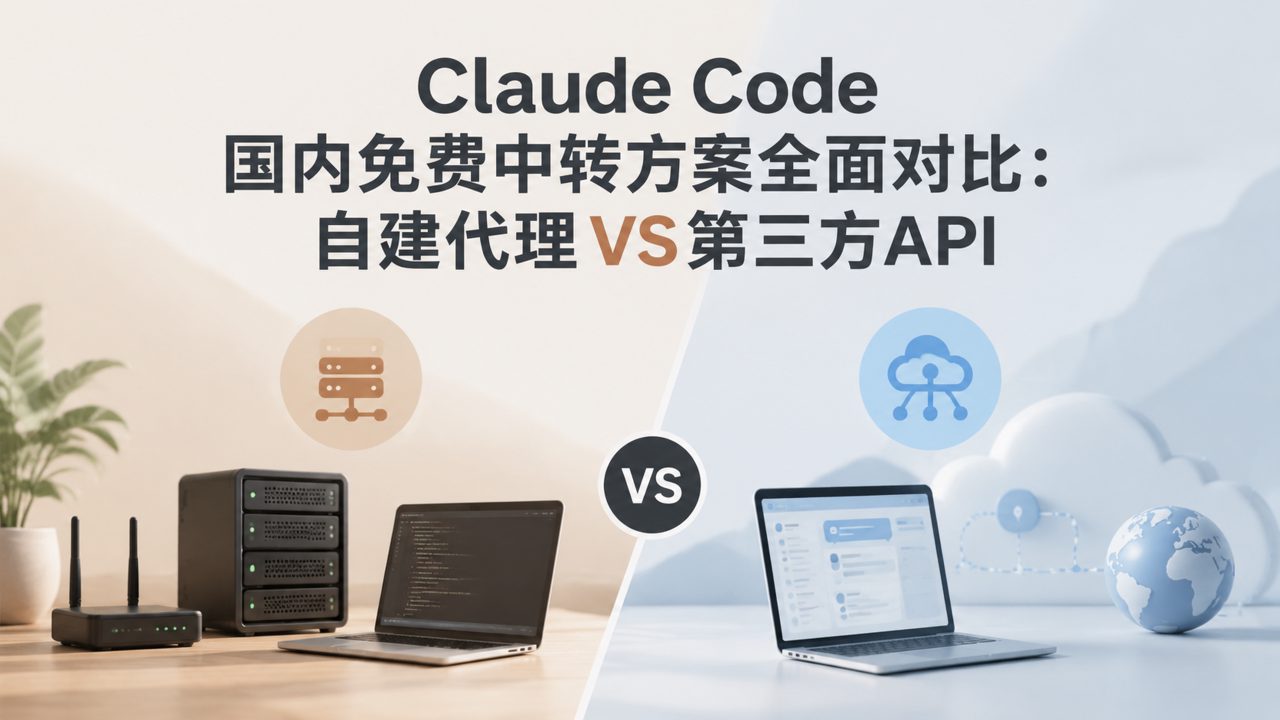
Domestic developers wanting to use Claude Code face two hurdles: the $10 monthly subscription fee and network connectivity. Claude Code’s official API has usage limits, and by default it routes through overseas servers, making direct domestic access basically unusable. This has led to several "workaround" solutions — some people set up their own proxy on overseas servers, others buy third-party relay API services, and some directly use modified tools like clawdfree that bypass subscriptions and include relay routes. Today we'll compare these mainstream approaches to see which suits you better.
Approach 1: Official Subscription + Self-built Proxy
This is the most "orthodox" path. Subscribe to Claude Pro ($10/month), set up a proxy on an overseas VPS, and access via the proxy from your local terminal. The advantage is you get the latest official version with all features updated synchronously. The drawbacks are obvious: you need an overseas server ($5-15/month), you must configure the proxy, and you have to deal with IP restrictions and bans. Also, the official Claude Code has strict limits on free tier usage — a few hours of heavy use will exhaust the quota.
Total monthly cost is around $15-25, not counting the time spent on setup. If your usage is light and you don't mind maintaining a proxy, this path is viable. But for daily heavy use, the cost-effectiveness and stability of a self-built solution are lacking.
Approach 2: Third-party Paid Relay API
Many domestic providers offer Claude API relay services — you buy their API Key and directly access Claude Code. The benefit is no need to set up networking yourself; interface compatibility is good, and many support mixing GPT and Claude. However, the problems are: first, pricing is opaque — billed by token, and heavy usage can make monthly costs far exceed the official subscription; second, the stability and data security of intermediaries are not guaranteed — they might shut down or restrict concurrency at any time; third, some relay services require registration and real-name authentication, increasing privacy risks.
Suitable for occasional users who aren't sensitive to cost and privacy. If you just write a few scripts or ask a few questions, these services are passable. But for high-frequency developers, every request is metered, and monthly expenses can easily surpass the official subscription.
Approach 3: clawdfree — No Subscription + Built-in Relay
clawdfree takes a different approach — it's based on Claude Code v2.1.88, modified to remove the official subscription check and change the default API route to a domestically accessible relay. You don't need a subscription or your own proxy — just download it, configure the relay API address, and use it. Under the hood, it still calls the official model, but the upper layer bypasses account verification and network blocking.
In practice, core features (auto-coding, file editing, terminal integration, bug fixing) all work normally. Since it's based on version 2.1.88, key capabilities haven't been cut. The only limitation is: you still need a usable relay API Key (clawdfree itself doesn't lock you to a specific provider; you can connect multiple relay sources). But compared to the official subscription + self-built proxy approach, this saves you the "register + subscribe + configure proxy" steps.
For most domestic developers, this is currently the lowest-barrier solution — zero subscription fee, network costs depend only on the relay API price you find (many have free tiers or very low billing), and switching routes is flexible.
Horizontal Comparison: Which is More Reliable?
| Comparison Item | Official Subscription + Self-built Proxy | Third-party Paid Relay API | clawdfree No-subscription Relay |
|---|---|---|---|
| Monthly Cost | $15-25 (subscription + VPS) | Pay-as-you-go, more expensive for high frequency | $0 (bring your own relay API, as low as a few cents) |
| Network Barrier | Need to configure proxy yourself | Provided by vendor, but depends on vendor | Built-in relay adaptation, zero configuration |
| Feature Completeness | Official latest version, complete | Depends on relay compatibility | Based on v2.1.88, core features complete |
| Maintenance Cost | High (need to maintain VPS and proxy) | Medium (need to test service providers) | Low (download and use, just swap keys) |
| Suitable Scenarios | Willing to spend money for convenience, have ops skills | Occasional calls, don't mind pay-as-you-go | High-frequency use, seeking low-cost entry |
An Often Overlooked Point: The Cost of the API Key Itself
No matter which solution you choose, as long as you're calling the real Claude model, the token consumption cost of the API is unavoidable. The official subscription is monthly but has usage caps; self-built proxies also can't escape token billing. clawdfree only saves you the subscription fee and network setup costs — you still need to find a suitable relay API to get model responses. The good news is that several domestic mainstream relay providers offer free trial quotas for new users, or packages far cheaper than official pricing — you can test with free credits first, confirm stability, then decide whether to pay.
Conclusion: Don't Choose Blindly — Know Your Usage
If you're just trying it out, or only need to handle a few small tasks daily, finding a reliable relay API combined with clawdfree is currently the most hassle-free combination — zero subscription, zero network configuration, controllable costs. If you use it heavily every day, need the latest features, and are willing to spend money to save time, then the official subscription + self-built proxy remains the most reliable option. Third-party paid relay APIs are suitable for intermediate users who "don't want to set up an environment, don't mind pay-as-you-go, and have light usage."
Don't be fooled by the word "free." The real cost lies in your time and stability requirements. The value of clawdfree is not making Claude Code completely free, but lowering the entry barrier for domestic developers from "$15/month + set up a proxy" to "just find a relay API." From this perspective, it is indeed the most practical starting point.
Comments
Leave a Comment