I recently took over a Node project where a third-party API occasionally returns a status code of 200 but with an empty body. After hours of debugging, local logs showed nothing unusual, and I tweaked parameters multiple times. What I really needed wasn't an IDE lint check, but something that could run a full analysis directly in the terminal alongside the code—exactly the kind of experience you'd imagine with Claude Code.
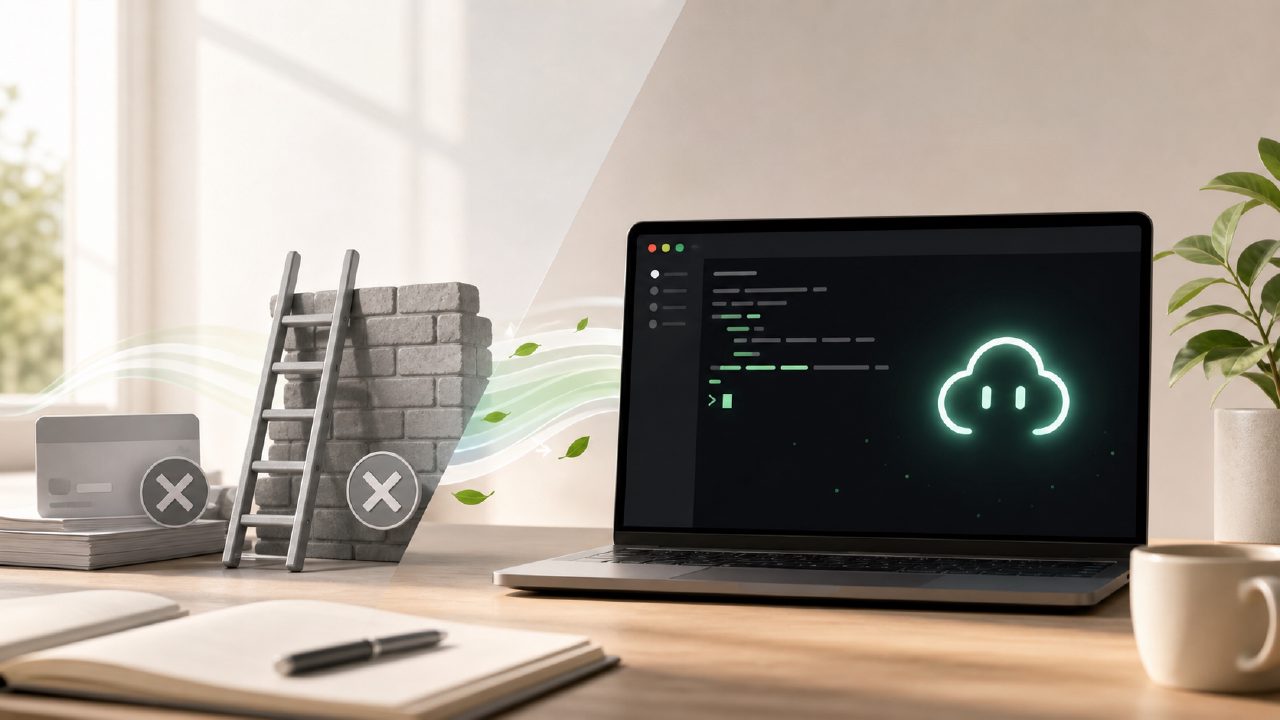
But going the official route with Claude Code requires not only an overseas payment method for a Pro subscription but also a stable network environment to route traffic out. The reality for many developers is: you just want to fix a bug temporarily or study an open-source project over the weekend, without the hassle of setting up a subscription and a proxy. That's exactly the pain point clawdfree solves: it removes the subscription barrier and handles the relay routing for you.
Below, I'll walk through a concrete debugging scenario to demonstrate the full workflow—no subscription accounts needed, no need to configure a proxy yourself.
Scenario: Debugging an API anomaly with clawdfree
Suppose the project I'm working on throws an error that's hard to reproduce. The flow goes like this: a user uploads a CSV, the server parses it and calls an external cleaning API for each row. Occasionally, one row returns blank, but the logs only record the final failure, making it impossible to tell which parameter caused it.
In the past, I'd scatter console.log statements at key points, re-run, and sift through the output. But with Claude Code, once you set the context, you can dive straight into analysis. The problem is the tool's own barriers:
1. You need a valid Claude subscription
2. The CLI tool's network requests must be able to reach the service
What clawdfree does is skip both steps. It's built on Claude Code v2.1.88, with two key changes: removal of subscription verification and inclusion of built-in relay route configuration. You only need to get a relay API Key, and you can use it just like the original Claude Code.
Step-by-Step Walkthrough
Step 1: Download and configure
Download the executable for your system from the clawdfree project page. No need to install Python or Node runtime—it's a compiled binary. Just drop it into your project root directory.
Step 2: Configure relay API information
Create a .env file in the project root, or directly edit the provided config.json, filling in three fields:
- API endpoint (e.g., the relay address of a provider)
- API Key (the string provided by the relay service)
- Model selection (default is claude-sonnet 4.0; adjust if your relay only supports specific models)
No official Claude account info is needed here—the verification step has been removed.
Step 3: Start the interaction
Run in the terminal:
./clawdfree
It will scan all relevant files in the current directory (auto-detecting based on your project's language) and enter a Q&A mode. You can paste the core CSV parsing function and ask it to analyze possible null / blank return causes.
No network timeouts, no subscription expiration pop-ups. As long as your relay API Key is valid and has quota, it works—nearly identical to the official version in terms of experience.
Step 4: Drill down with context
For example, I might ask: "In this code, which line might cause csvRow['email'] to be undefined without being caught?"
It will pinpoint a forEach loop that lacks an explicit null check. I then follow up with a specific example parameter's result, and it generates a diff with a suggested fix directly in the terminal.
Throughout the whole process, I never left the terminal or opened a browser to check Claude's conversation history.
Important Details to Note
While clawdfree eliminates subscription and network issues, there are a few things to keep in mind when using it:
- Latency differences across relay providers. I tested two relay services; the first had a Time to First Token (TTFT) of 2 to 3 seconds, while the second kept it around 0.8 seconds. For data-heavy or multi-turn scenarios, this difference noticeably affects the feel.
- API costs are not zero. Claude Code itself is billed per token. While you save the $20/month subscription fee, relay API Keys are typically pay-as-you-go. A heavy debugging session can consume hundreds of thousands or even millions of tokens. If you use it frequently, keep an eye on quota consumption.
- Maintenance and update pace. Since this is a modified version based on v2.1.88, if the official version adds new features (e.g., MCP protocol enhancements or new file write permissions), clawdfree requires the author to manually merge updates. If the features you need are only available in a newer official version, you'll need to decide whether to wait for the author's release.
Also, it essentially removes the official strict billing and authentication modules. If your team has compliance requirements (e.g., code cannot leave the internal network, or third-party relay services cannot transmit full code content), this solution is not for you. But for individual developers, freelancers, or small project teams, it's a very practical shortcut.
From a practical standpoint, clawdfree solves that very specific problem: you don't want "subscription" and "network" to be barriers to trying an AI coding assistant. Without any extra architectural work, a single binary file plus a one-line configuration—and that CSV parsing bug I mentioned? It took ten minutes to identify.
Comments
Leave a Comment